

Premium hybrid caladium plants developed for stronger color patterns, unique leaf shapes, and stable plant growth.
Selected for collectors and international plant buyers.
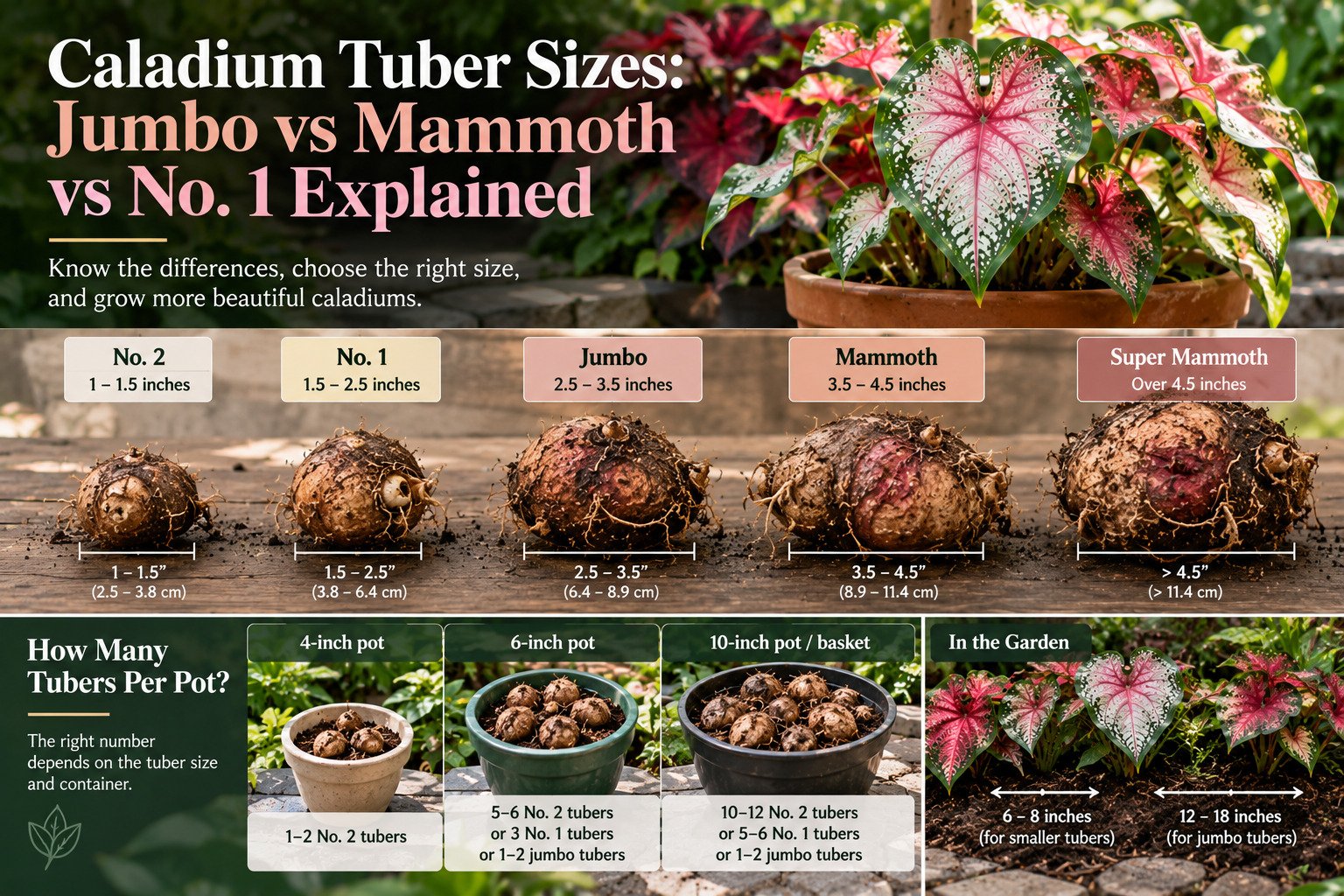
If you’ve ever shopped for caladiums, you’ve probably seen labels like “No. 1,” “jumbo,” or “mammoth” and wondered what they actually mean. Understanding caladium tuber sizes helps you buy the right amount, plant at the right spacing, and avoid paying for more than you need. This guide explains each size grade, how many tubers to put in a pot, and when a bigger tuber is truly worth the price.
Caladium tubers are sold by grade, and the grade reflects the tuber’s diameter. According to University of Florida IFAS research, larger tubers are multi-segmented and carry several dominant buds. Each bud can produce its own leaves, so a bigger tuber generally gives you a fuller plant right from the start. For example, jumbo tubers of some cultivars bear four to six dominant buds, while others carry six to nine.
University of Florida IFAS researchers grade tubers by their maximum diameter, and LSU AgCenter lists the same measurements for gardeners. Here is how the grades compare:
| Grade | Diameter | Typical use |
|---|---|---|
| No. 2 | 1 to 1.5 inches | Small pots, bulk planting |
| No. 1 | 1.5 to 2.5 inches | Single plants in small to medium pots |
| Jumbo | 2.5 to 3.5 inches | Large containers and garden beds |
| Mammoth | 3.5 to 4.5 inches | Statement plants and landscapes |
| Super mammoth | Over 4.5 inches | Rare, mainly for large displays |
Some suppliers also sell a smaller No. 3 grade, so always check the exact measurement in the listing. Growers’ guidance notes that the two largest grades are mainly used for landscape planting.
The right number depends on the grade and the container. As a general guideline from commercial growers, you can use these amounts:
Treat these numbers as a starting point and adjust for your variety. For container basics, see can caladiums grow in pots.
In garden beds, LSU AgCenter advises planting tubers smooth side down at about two and a half to three inches deep. Growers commonly space smaller tubers around six to eight inches apart, while jumbo tubers need far more room, often 12 to 18 inches. For the full planting method, read how to plant caladium bulbs for healthy and strong growth.
Often, yes, but not always. Smaller tubers cost much less, but you need more of them to fill a pot. Larger tubers cost more each, yet fewer are needed to achieve the same effect. In fact, University of Florida IFAS researchers weight the grades at 1 for No. 2, 2 for No. 1, 4 for jumbo, and 6 for mammoth when comparing their value, based on relative market prices from Florida producers. In other words, price rises steadily with size.
If your budget is tight, smaller tubers are a sensible choice for mass plantings. If you want an instantly full pot, one jumbo tuber can be better value than several small ones. For a wider look at what drives cost, see our rare caladium price guide.
Each tuber has a large central bud surrounded by smaller secondary buds. Commercial growers often remove the central bud, a technique called de-eyeing, to produce a fuller plant with more leaves on shorter stems. Growers who use it make a shallow cut about a quarter inch across and only a fraction of an inch deep, and they allow about a week or more of extra growing time. If your goal is a few very large leaves instead of a bushier plant, you may prefer to leave the central eye alone.
For more on how eyes work when dividing tubers, see how to propagate caladiums from tubers.
Not sure which variety suits your space? See how to choose the right caladium for your home and garden.
Bigger tubers generally produce more leaves, because they carry more buds. Leaf size also depends on the variety, light, and feeding, so see how to make caladium leaves grow bigger for more tips.
With good care, small tubers often bulk up during the growing season, so they are a fine choice. They simply look less full at first.
Ask the seller. Size affects both price and how full your plant looks, so it is worth confirming before you buy. If a tuber fails to grow after planting, our guide on caladium tubers not sprouting can help.
Once you understand caladium tuber sizes, shopping becomes much simpler. For more detail, read the University of Florida IFAS publication on the Lava Glow caladium or the LSU AgCenter guide to caladium bulbs. When you’re ready to buy, explore premium Indonesian caladium plants for collectors worldwide, carefully packed and shipped, at Greenos Plantcific.
Contact Us